MultiCube: Compositional 3D Generation With Part-Level Semantic and Spatial Control
- Ava Pun1,2
- Kangle Deng1
- Yiheng Zhu1
- Jun-Yan Zhu2
- Maneesh Agrawala1,3
- Tinghui Zhou1
- 1 Roblox
- 2 Carnegie Mellon University
- 3 Stanford University
Overview
MultiCube generates part-level 3D objects conditioned on text prompts. Users have fine-grained control over the part semantics and spatial arrangement, specified via text part labels and axis-aligned bounding boxes.
Every generated mesh on this page responds to the mesh view control in the bottom-right corner: show it on its own, overlaid with the input bounding boxes, or exploded into parts.
Spatial control
Users have full control over the spatial layout of the generated parts.
Semantic control
Users can even specify different part semantics for the same spatial layout, resulting in unique output designs.
Abstract
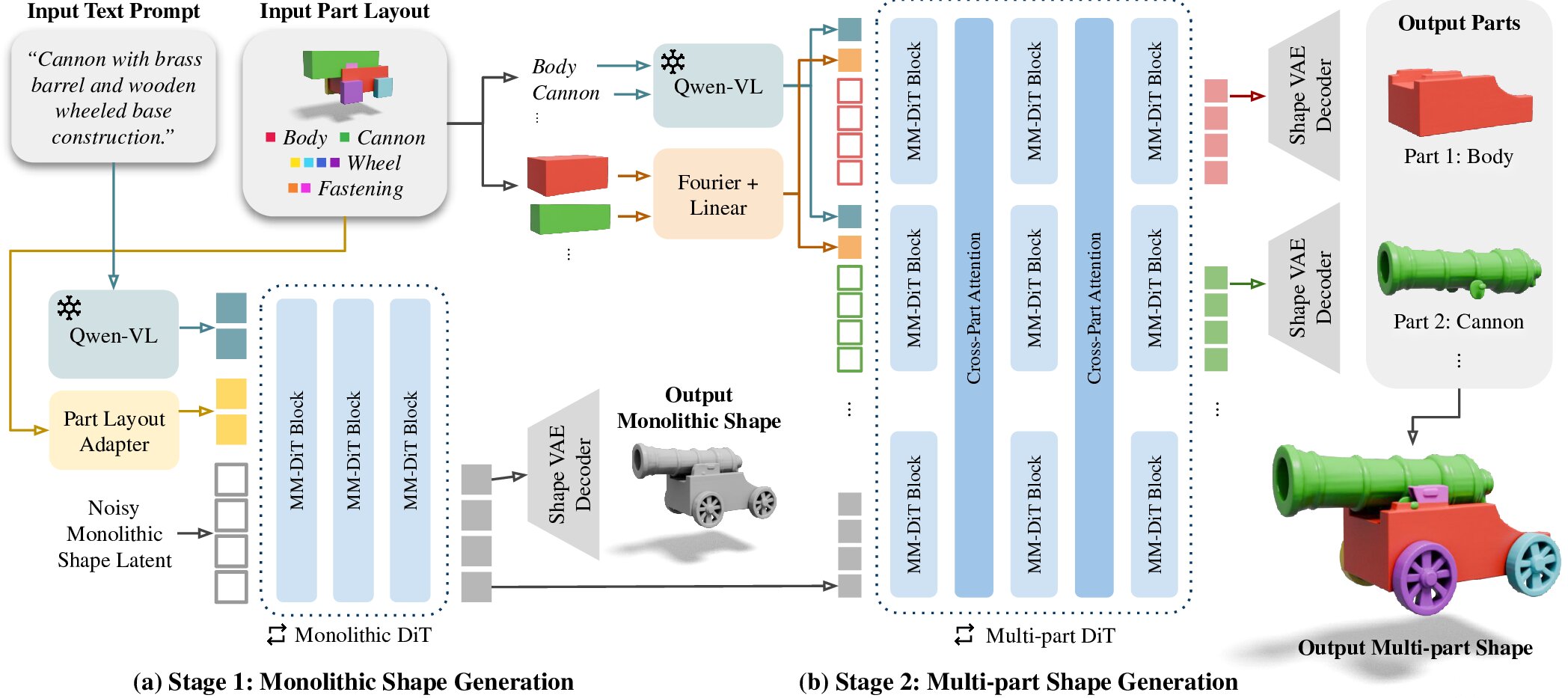
Digital 3D objects used in games and animation are often required to be compositional; that is, decomposed into semantically meaningful parts. Recent 3D generation methods can produce high-quality compositional objects conditioned on image or text prompts. Yet, such global conditioning lacks the precise part-level controllability required for professional creative workflows. To address this, we introduce MultiCube, a novel compositional 3D generation method that provides explicit, independent control over both the semantics and spatial arrangement of each part. MultiCube takes as input a global text prompt, a text schema specifying the desired parts, and a spatial layout indicating the bounding boxes of the parts in the given schema. It outputs a 3D object composed of distinct meshes, one per specified part, that adhere to the given semantic and spatial conditions.
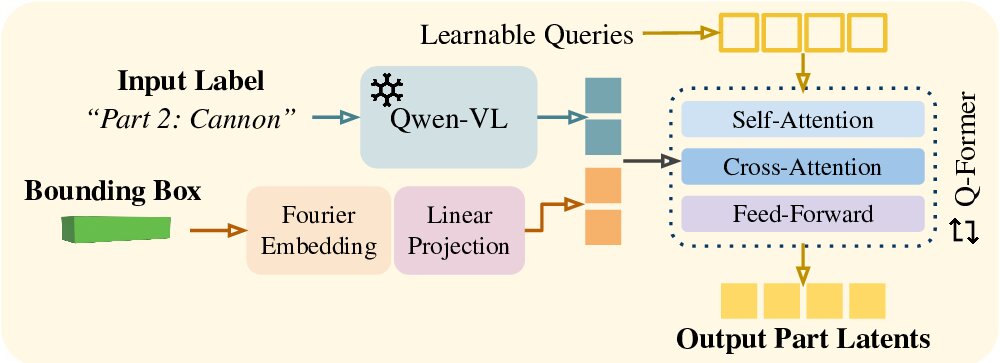
Our approach employs a two-stage diffusion process, first generating a schema- and layout-aligned monolithic mesh, then decomposing the mesh into individual parts simultaneously. A novel Part Layout Adapter is used to encode per-part conditions in a disentangled manner. Experiments demonstrate that our method can generate high-quality compositional 3D objects with precise part-level control, including those with unique layouts difficult to achieve with text or image prompting alone.
Method
MultiCube runs in two stages: it first generates a monolithic shape aligned to the prompt and the part layout, then decomposes that shape into one mesh per specified part.
Results
All part layouts in this section are generated by an LLM from the text prompt, rather than specified by hand.
Drag or use the arrows to move between examples, and drag inside a viewer to rotate the mesh.
Applications
Scene generation
Multi-object scenes can be generated with fine spatial control by treating each object as a “part.”
Part editing
A part can be revised by editing its bounding box or label, and regenerating.
Demo video
Demo video showcasing controllable part-level 3D generation with MultiCube. Played at 3× speed.
BibTeX
@misc{pun2026multicube,
  title         = {MultiCube: Compositional 3D Generation With Part-Level
                   Semantic and Spatial Control},
  author        = {Pun, Ava and Deng, Kangle and Zhu, Yiheng and
                   Zhu, Jun-Yan and Agrawala, Maneesh and Zhou, Tinghui},
  year          = {2026},
  eprint        = {2608.20448},
  archivePrefix = {arXiv},
  primaryClass  = {cs.GR}
}
Acknowledgements
We thank Gaurav Parmar, Maxwell Jones, Nupur Kumari, Ruihan Gao, Sheng-Yu Wang, Michael Palleschi, Maurice Chu and Kiran Bhat for their feedback and helpful discussions. This work was partly done while Ava Pun was interning at Roblox.